a) Đổi gốc tất cả vectơ về C:
\(\overrightarrow{MA} + \overrightarrow{MB} + 2\overrightarrow{MC} = \overrightarrow{0}\)
\(\Leftrightarrow \left(\overrightarrow{MC} + \overrightarrow{CA}\right) + \left(\overrightarrow{MC} + \overrightarrow{CB}\right) + 2\overrightarrow{MC} = \overrightarrow{0}\)
\(\Leftrightarrow 4\overrightarrow{MC} + \overrightarrow{CA} + \overrightarrow{CB} = \overrightarrow{0}\)
\(\Leftrightarrow 4\overrightarrow{CM} = \overrightarrow{CA} + \overrightarrow{CB}\)
Gọi I là trung điểm AB. Khi đó \(\overrightarrow{CA} + \overrightarrow{CB} = 2\overrightarrow{CI}\).
Thay vào: \(4\overrightarrow{CM} = 2\overrightarrow{CI} \Leftrightarrow \overrightarrow{CM} = \frac{1}{2}\overrightarrow{CI}\).
Vậy M là trung điểm của đoạn CI, tức là trung điểm của trung tuyến kẻ từ C trong tam giác ABC.
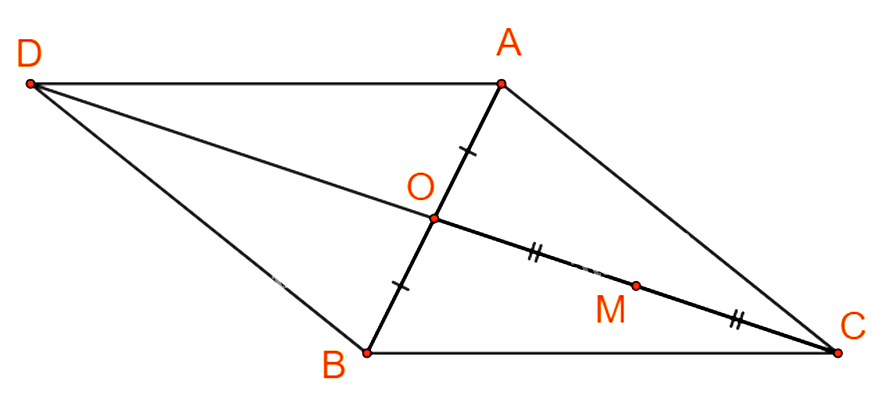
b) Với mọi điểm O, phân tích từng vectơ qua M:
\(\overrightarrow{OA} = \overrightarrow{OM} + \overrightarrow{MA}\)
\(\overrightarrow{OB} = \overrightarrow{OM} + \overrightarrow{MB}\)
\(\overrightarrow{OC} = \overrightarrow{OM} + \overrightarrow{MC}\)
Cộng theo hệ số:
\(\overrightarrow{OA} + \overrightarrow{OB} + 2\overrightarrow{OC} = \left(\overrightarrow{OM} + \overrightarrow{MA}\right) + \left(\overrightarrow{OM} + \overrightarrow{MB}\right) + 2\left(\overrightarrow{OM} + \overrightarrow{MC}\right)\)
\(= 4\overrightarrow{OM} + \left(\overrightarrow{MA} + \overrightarrow{MB} + 2\overrightarrow{MC}\right)\)
\(= 4\overrightarrow{OM} + \overrightarrow{0} = 4\overrightarrow{OM}\)
Vậy với mọi điểm O, ta có \(\overrightarrow{OA} + \overrightarrow{OB} + 2\overrightarrow{OC} = 4\overrightarrow{OM}\).
