a) \(y = \dfrac{2x^2 - x + 4}{x - 1}\)
1. Tập xác định: \(\mathbb{R} \setminus \{1\}\).
2. Sự biến thiên:
Chia đa thức: \(y = 2x + 1 + \dfrac{5}{x - 1}\).
Đạo hàm: \(y' = 2 - \dfrac{5}{(x-1)^2}\).
\(y' = 0 \Leftrightarrow (x-1)^2 = \dfrac{5}{2} \Leftrightarrow x - 1 = \pm\dfrac{\sqrt{10}}{2} \Leftrightarrow x = \dfrac{2 - \sqrt{10}}{2}\) hoặc \(x = \dfrac{2 + \sqrt{10}}{2}\).
Xét dấu \(y'\):
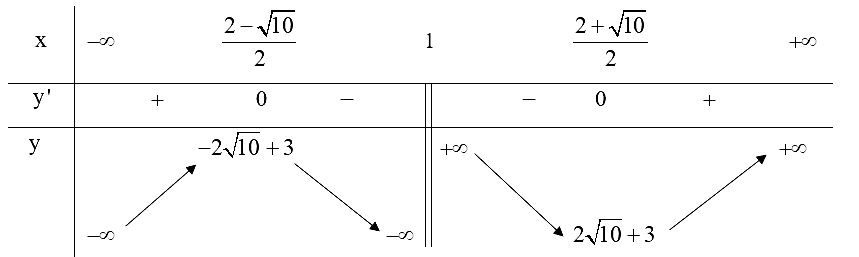
- Trên \(\left(-\infty;\, \dfrac{2-\sqrt{10}}{2}\right)\) và \(\left(\dfrac{2+\sqrt{10}}{2};\, +\infty\right)\): \(y' > 0\), hàm đồng biến.
- Trên \(\left(\dfrac{2-\sqrt{10}}{2};\, 1\right)\) và \(\left(1;\, \dfrac{2+\sqrt{10}}{2}\right)\): \(y' < 0\), hàm nghịch biến.
Cực đại tại \(x = \dfrac{2-\sqrt{10}}{2}\): \(y_{CĐ} = 3 - 2\sqrt{10}\).
Cực tiểu tại \(x = \dfrac{2+\sqrt{10}}{2}\): \(y_{CT} = 3 + 2\sqrt{10}\).
Tiệm cận:
- \(\lim_{x \to 1^-} y = -\infty\), \(\lim_{x \to 1^+} y = +\infty\) → tiệm cận đứng \(x = 1\).
- \(\lim_{x \to \pm\infty} \left[y - (2x+1)\right] = \lim_{x \to \pm\infty} \dfrac{5}{x-1} = 0\) → tiệm cận xiên \(y = 2x + 1\).
Bảng biến thiên:
3. Đồ thị:
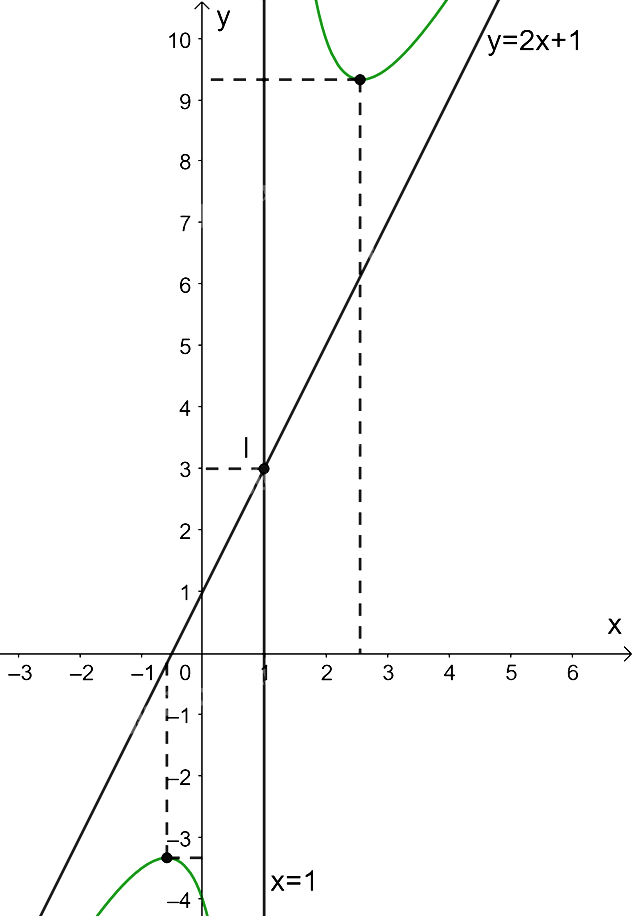
Giao với trục tung: \((0;\, -4)\). Đồ thị không cắt trục hoành (tử \(2x^2 - x + 4 > 0\) với mọi \(x\)). Tâm đối xứng của đồ thị là giao điểm hai tiệm cận \(I(1;\, 3)\).
---
b) \(y = \dfrac{x^2 + 2x + 1}{x + 3}\)
1. Tập xác định: \(\mathbb{R} \setminus \{-3\}\).
2. Sự biến thiên:
Chia đa thức: \(y = x - 1 + \dfrac{4}{x + 3}\).
Đạo hàm: \(y' = 1 - \dfrac{4}{(x+3)^2}\).
\(y' = 0 \Leftrightarrow (x+3)^2 = 4 \Leftrightarrow x + 3 = \pm 2 \Leftrightarrow x = -1\) hoặc \(x = -5\).
Xét dấu \(y'\):
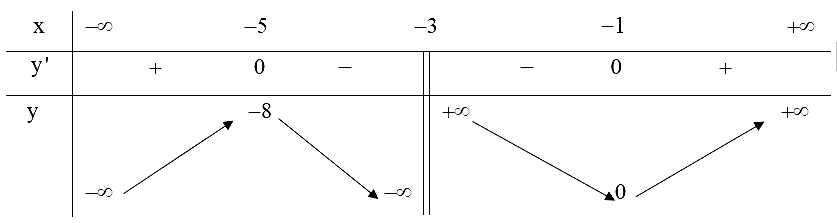
- Trên \((-\infty;\, -5)\) và \((-1;\, +\infty)\): \(y' > 0\), hàm đồng biến.
- Trên \((-5;\, -3)\) và \((-3;\, -1)\): \(y' < 0\), hàm nghịch biến.
Cực đại tại \(x = -5\): \(y_{CĐ} = -5 - 1 + \dfrac{4}{-5+3} = -6 + (-2) = -8\).
Cực tiểu tại \(x = -1\): \(y_{CT} = -1 - 1 + \dfrac{4}{-1+3} = -2 + 2 = 0\).
Tiệm cận:
- \(\lim_{x \to -3^-} y = -\infty\), \(\lim_{x \to -3^+} y = +\infty\) → tiệm cận đứng \(x = -3\).
- \(\lim_{x \to \pm\infty} \left[y - (x-1)\right] = \lim_{x \to \pm\infty} \dfrac{4}{x+3} = 0\) → tiệm cận xiên \(y = x - 1\).
Bảng biến thiên:
3. Đồ thị:
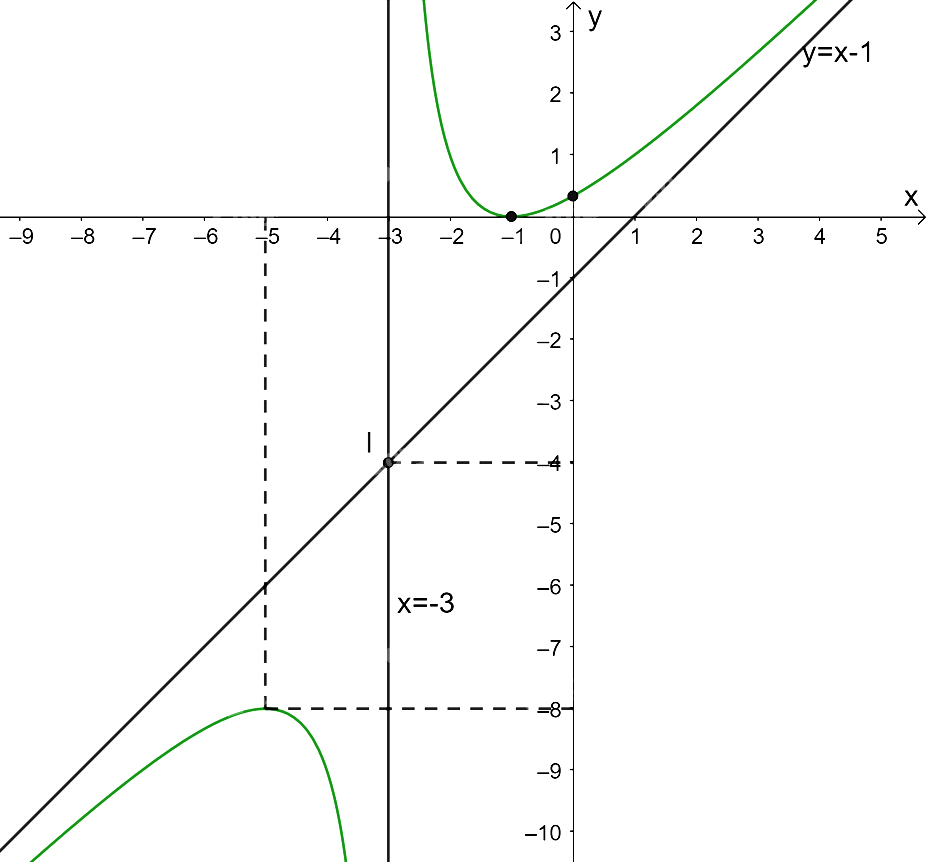
Giao với trục tung: \(x = 0 \Rightarrow y = \dfrac{1}{3}\), điểm \(\left(0;\, \dfrac{1}{3}\right)\).
Giao với trục hoành: \(y = 0 \Leftrightarrow x^2 + 2x + 1 = 0 \Leftrightarrow (x+1)^2 = 0 \Leftrightarrow x = -1\), điểm \((-1;\, 0)\).
Tâm đối xứng của đồ thị là giao điểm hai tiệm cận \(I(-3;\, -4)\).
